

Gemstone Facts
How to Examine a Colored Gemstone
So, you got a notice that you have a package waiting for you! You rush home with it straight from work, and, since it is already dark outside, you take it into the brightest room in your house, the kitchen! You tear open the box, and there, under the hideous fluorescent (or incandescent) lights, you examine your … Wait! Unless you spend all your time in this room, this setup is not really going to give you an accurate “first impression” of how this stone will look every day.
So what is the best way to examine a colored gem? Here is what gem dealers do: If you live in the Northern Hemisphere, stand indoors, in front of a window on the north side of the building between 11am and 2pm. The sun will be at its highest point in the sky, and you won’t get any glare. Turn your back to the window and hold the stone in front of you, with table parallel or nearly parallel to the window, but not in your shadow. (We like to leave the gem box lid on when we do this!) Same directions for the Southern Hemisphere, only use a south side window. This will allow you to see the color and brilliance, or lack of it. Then, remove the stone from the box and “set” it between your fingers, this will give you an idea of how it will look mounted. Indoors is better than outdoors because outside sunlight is far too intense most hours of the day for an accurate color reading. Mid-day is best since morning and evening sun are very different and will be less neutral (see the Purkinje shift article below under “Light and Color 101”).
Note: Contrary to most gemstones, blue sapphires and most other blue stones look lovely in fluorescent lighting, yes, “shop” lights. Do not use these as the basis for making a purchase of a sapphire. Just because every other stone looks rotten under them, you might think, ‘wow, if this sapphire looks good under these lights, it must be great!’ No! Fluorescent lights emphasize the blue end of the color spectrum…which is why people look terrible under them.
So what are you looking for when you examine this stone?
First and foremost, in the colored gemstone world, color is king. But… what may be considered “top color” by the trade, may do nothing for you.
Do you like the color? That’s #1.
Evenness of color – No zoning or “stripes” should be visible looking straight down the table to the culet (point).
Well proportioned cut – Does the stone reflect light fairly evenly throughout the stone? Or are there spots that stay dark? That would be extinction. Can you see right through the stone from table to culet, with facets seeming to be only around the edges? That is windowing.
Clarity – At first glance, do any internal inclusions jump out at you? Are they going to bother you, or do you like the character they add? (See Clarity Grading below)
Remember that when the stone is set, it will be set with the table flat on top, and pavilion (bottom) covered, or mostly covered. The side view and bottom-up view is not going to show when you wear it, and, while interesting to examine, will be irrelevant when mounted.
How Big?
Purchasing the right size colored stone is not the same as taking the equivalent size diamond and saying, “I want a 2 carat sapphire to replace my old 2 carat diamond”. Every stone has a different specific gravity, some lighter, some heavier than diamond. For accuracy, take a measurement gauge and go by the millimeter size to get it right. Most diamond websites have a chart showing the diamond mm. size and equivalent carat weight. You can do a search for: “Diamond Size Chart” for a good visual on mm. size relative to ct. weight.
Light and Color 101
Also see Hue, Tone and Saturation in glossary below
Most people know that the phenomenon of color is a reflection of light, the color your eyes see in an object is actually the color in the light spectrum that it does not absorb, but rather reflects back to your eye. These two things, color and light, are inextricably intertwined, light is color and color is light.
In the paint department at the big box hardware stores you can often check paint chips under 3 different lights. Why? Because the color will look different depending on the light it is under. You will notice that even in a room with all walls painted the same color, each wall may look slightly different depending on the placement of windows and direction of light coming in from them.
But what does this mean in the world of gemstones? That, to a greater or lesser extent, every gemstone will exhibit different colors in different lights.
There is no such absolute as “natural light” or “the color in real life.” Whose life?
We cannot put it any better than this excerpt taken from Pala Gems website:
“One day, many years ago, a man named Johannes von Purkinje went walking in the fields at dawn. He observed that blue flowers looked brighter than red flowers. Later that day, when the sun was overhead, the red flowers looked brighter than the blue ones. Conclusion? The human eye is more sensitive to blue when the light is dim and red when the light is strong. This phenomenon is called the Purkinje Shift. Because of it, flowers that are bright red on a sunny afternoon look bluish-red toward evening (Varley, 1980)”
And regarding lighting conditions, locations, and gemstones, from the same website:
“if you are looking at stones under skylight and are in San Francisco, New York, London, Amsterdam, Antwerp—or any other major gemstone center well north of the equator—then northern skylight is generally preferred. If you are south of the equator (Brisbane, Santiago, etc.), southern skylight is the general rule…We also observed that the quality of natural light varies dramatically with latitude, weather conditions, atmospheric pollution, season and the sun’s position in the sky. All contribute to the strength and spectral composition of what we call natural daylight. Consequently, a gem seen under daylight can and does change appearance relative to where we are, what the weather is like, the degree of pollution, the season, and the time. It is therefore incorrect to think of daylight as a standard light source. For something to be standard it should have constant properties, which global daylight does not. If daylight were constant everywhere, that dark stone bought in Bangkok would not look darker in New York or Amsterdam. Nor would a blue sapphire necessarily look better at 5 PM than at 1 PM – even at the same latitude!” -To read the entire article: http://www.palagems.com/gem_lighting1.htm
True Story: In the early 90’s we made a trip to Bangkok where we purchased some gorgeous Thai sapphires. We inspected them in daylight and felt they would be a good purchase, based on their color and price. When we got them home to San Diego, what a disappointment! They were not nearly the same vibrant hue as they were in Thailand, located much closer to the Equator.
To complicate the issue just a little more, our eyes also play a major role in color perception. From Wikipedia under the heading of “Color” : “Because perception of color stems from the varying spectral sensitivity of different types of cone cells in the retina to different parts of the spectrum, colors may be defined and quantified by the degree to which they stimulate these cells.”
Therefore, the color of any object depends on three things: the object itself, the eye that views it, and the light source.
It is important to note that the colors of gemstones are colors of the light spectrum. Because of the interplay of light, gem colors are not the same as RGB, CMYK or “paint chip” colors, which is the reason they are impossible to capture with 100% accuracy online or in print. One person described colored stones as ‘ boxes full of windows and mirrors’. (Factor in an assortment of internet browsers displaying widely varied color enhancement, which can really skew true colors.)
When we give a Pantone color card number for reference on our web listings, it is the overall color of the gem in North facing daylight, in Southern California. Often we give 2 numbers, a lighter one for the color when light is hitting the facets, and a darker one for the facets in shadow. These are useful only with the color cards, not the RGB online colors. Still, Pantone cards are solids and not transparent like gems. (Sigh)…so far, it’s the best we can do.
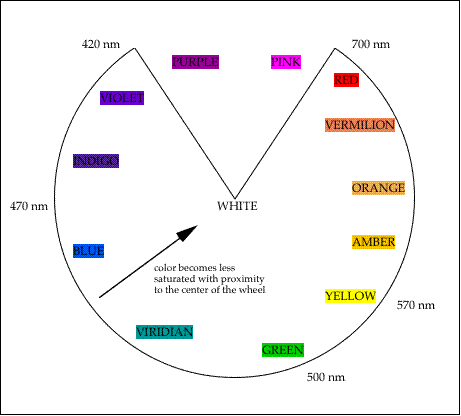
Below is a color circle (not the same as a “color wheel” for solid textiles or mixing paint) based on additive combinations of the light spectrum, after Schiffman (1990). Credit: http://en.wikipedia.org/wiki/Color_wheel
Measuring Gem Hardness
Mohs’ scale Vs. Scale of absolute hardness
For years, jewelers and the general public have used the Mohs Scale like a purchasing bible to determine “hardness” of gemstones. But is ease of scratching the same as toughness? Is a stone that scratches easily a “soft” stone?
Is a stone with a higher Mohs number a “tougher” stone?
A little history lesson: in 1812 Frederich Mohs selected 10 minerals that were common (200 years ago), and arranged them from 1-10 based on scratch tests. As in, number 10 could scratch number 9, number 9 could scratch number 8, etc. 1 is talc, 10 is diamond. I’ve always wondered how he got the gypsum to scratch the talc…but I digress.
The Mohs’ Scale of Hardness has been called “relative” and even “arbitrary” by experts in gemology and geology. Why? First of all, this table is not proportional, for example an 8 is not twice as hard as a 4, a diamond at “10” is actually 400% harder than corundum which is “9”. Secondly, it is not specific enough for gems. What does it mean when a stone is a 6.5 – 7? Is it a 7, or a 6.5? Also this table gives the false impression that a stone that is an 8 is “hard” and therefore safe for an everyday ring. Not true if that stone is an emerald. The fact that emerald is 7.5-8 only means it can scratch a 7, but being brittle, is not a good candidate for a ring unless it is in a very protective setting (see Hardness Vs: Toughness below). We would choose a zircon, even at 6.5, any day over an emerald!
Much more accurate for gemology is the Turner-sclerometer test, also called the Absolute Hardness scale. It consists of microscopically measuring the width of a scratch made by a diamond under a fixed load, and drawn across the face of the specimen under fixed conditions. This table is proportionate, a topaz (200) being twice as hard as quartz (100), corundum (400) twice as hard as topaz.
Here is a side by side comparison of the 2 scales:
Mohs | Absolute | Mineral or | Other Materials |
1 | 1 | Talc | Sulfur |
2 | 2 | Gypsum | Gold, Silver (2.5-3) |
3 | 9 | Calcite | Pearl, Coral, Malachite |
4 | 21 | Fluorite | Platinum (4-4.5) |
5 | 48 | Apatite | Lapis Lazuli, Turquoise, Opal Knife Blade (5.5) |
6 | 72 | Orthoclase | Moonstone (6-6.5), Tanzanite (6.5-7) Peridot(6.5-7), Window Glass (6.5-7) Steel File (6.5), Zircon (6.5-7.5) |
7 | 100 | Quartz | Citrine, Amethyst, Tourmaline (7-7.5) Garnet(7-7.5), Hardened Steel (7-8) Emerald (7.5-8), Aquamarine (7.5-8) |
8 | 200 | Topaz | Topaz, Alexandrite (8.5) |
9 | 400 | Corundum | Ruby, Sapphire |
10 | 1500 | Diamond | Diamond |
Hardness, or Toughness?
SOME of our customers have been told if they plan on an everyday ring, the only colored stone they can have in it is a sapphire. Why? At 9 on the Mohs’ scale, it is believed that every other colored stone is inferior in “hardness”, and thus it is argued, “too soft”. Problem is, not everybody likes sapphire, and not everybody can afford one as nice as they would like. Besides, as is demonstrated above, the old Mohs scale is too arbitrary for rating gemstones. Good for talc though.
We have been cutting, repairing, and repolishing gems for over 30 years. Over the years we have seen the “after” picture for nearly every colored stone. A huge factor not to be ignored is the person themselves, and how they wear their jewelry. We have seen sapphires abraded into gravel, and Tanzanites worn everyday for years without a scratch. Another large part of the wear-ability factor is the setting. Can we say that again? The setting. Even a diamond can chip if you set it in a high prong setting. For a stone to be a good choice for everyday, it has to be “tough”, which is not necessarily the same as “hardness” on the Mohs scale.
True story: At a gem show a few years back, we were showing a gentleman a large pink spinel. He was a little concerned about the “toughness” of the stone. As we were speaking, the tweezers he held in his hand twisted and the spinel went shooting across the cement floor. Fortunately we found it right away, and upon examining it, it didn’t have even a scratch.
He bought it of course!
Clarity Grading
Unfortunately, there is no universally accepted standard grading system for colored stones. Due to this fact, many vendors have invented their own grading systems. The most commonly used independent grading system is from GIA, it is what we also use. Although the symbols and terminology they use (for example “VVS”) is the same as they use for diamonds, the actual clarity grading system is very different from diamond grading. First of all, instead of one singular category, colored stones fall into one of 3 main categories. Comparing a nearly-always-included emerald to a nearly-always-clean quartz for example, is not comparing apples to apples. Because of this disparity, colored stones have been divided into Type I, II, and III stones. Each of these categories is then divided into clarity grades. The one grade you will not find in colored stones is “Flawless”. The ‘cleanest’ colored stone you will find would be a Type I stone, VVS clarity. VVS stands for “very, very slight” inclusions.
What does “eye clean” mean within the gemstone industry?
Well, what it does not mean is ‘nothing visible to the eye in any direction when viewed as close as possible’.
What this trade-originated term does mean is, when viewed by a person with normal 20/20 vision, from 10-12 inches away, with the stone face-up, under diffused lighting conditions, it will not have any visible inclusions.
Why these specific circumstances? 10-12 inches is considered the standard distance from your eye to the top of a table when seated. (Personally, we at Gemfix call a stone “eye clean” at more like 6-8 inches from the eye.)
Face up, of course, is the view it will have when set. And obviously, diffused lighting will enable you to see more clearly, without a harsh glare.
A Type III stone of VVS clarity however, will have visible inclusions under the same conditions, but
since it is a Type III stone, this is a given. Emeralds are Type III stones and are still extremely valuable.
It is important to mention that there is a distinct difference between “seeing” an inclusion with the naked eye, and “finding” an inclusion with the naked eye. What is the difference? Most people will see a stone as “eye clean” until they loupe it 10x magnification, then no longer believe it was ever eye clean. Your eye will forever after zoom in on where you now “know” the inclusion to be, and will spot it instantly.
Remember, colored gems are stones, products of the earth and thousands of years of nature’s handiwork, not glass.
And colored stones are never ‘F’ for ‘Flawless’.
GIA CLARITY TYPES
| Type I Usually eye clean | Type II | Type III |
| Aquamarine Chrysoberyl, yellow and green Heliodore Morganite Quartz, smoky Spodumene, all Tanzanite Tourmaline, green Zircon, blue | Andalusite Alexandrite Corundum, all (Sapphires, Rubies) Garnet, all Iolite Peridot Quartz, amethyst, citrine, ametrine Spinel, all Tourmaline, all but green, red/pink and watermelon Zircon, all but blue | Emerald Red Beryl Tourmaline: red/pink and watermelon |
CLARITY GRADES
| Type I | Type II | Type III |
VVS | Minute inclusions, difficult to see under 10X. Eye clean. | Minor inclusions, somewhat easy to see with 10X. Usually eye clean. | Noticeable inclusions under 10X. Usually eye clean. |
VS | Minor inclusions, somewhat easy to see with 10X. Usually eye clean. | Noticeable inclusions under 10X. May be eye visible. | Obvious inclusions with 10X. May be eye visible. |
SI1 | Easily noticeable with 10X. Slightly visible to the unaided eye. Usually low relief. | Obvious inclusions, large or numerous under 10X. Apparent to unaided eye. | Prominent to unaided eye. |
SI2 | Easily visible to the unaided eye. Usually low relief. | Obvious inclusions, large or numerous under 10X. Very apparent to unaided eye. | Very prominent to unaided eye. |
I1 | Moderate effect on appearance or durability. | Moderate effect on appearance or durability. | Moderate effect on appearance or durability. |
I2 | Severe effect on appearance or durability. | Severe effect on appearance or durability. | Severe effect on appearance or durability. |
I3 | Severe effect on both appearance and durability. | Severe effect on both appearance and durability. | Severe effect on both appearance and durability. |
Dcl | Not transparent | Not transparent | Not transparent |
Gemstone Care & Cleaning
You should not wear gemstone jewelry while playing sports, doing housework, washing dishes, or working with heavy equipment. Not only can it be damaged by a blow, but excessive perspiration can affect it adversely as well. Don’t wear it in a chlorinated pool or spa.
Do not allow your gemstones to come in contact with chlorine bleach, hair spray, perfume or other chemicals because they can pit or discolor the mounting. Get into the habit of putting your jewelry on after your beauty routine.
Don’t let your jewelry jumble together in the jewelry box. Gems as well as settings can get scratched by prongs, clasps and other stones.
A soft toothbrush with a mild dishwashing detergent is very effective to clean most gems. Window cleaner and a cotton swab is good in a pinch. Ultrasonic or steam cleaners are not safe for most colored stone jewelry! Never, ever, ever for an emerald!
Glossary Of Gem Terms:
Brilliance – The effect of light being reflected from a gemstone, sparkle, flash. See also “Scintillation”
Extinction – there are some misconceptions floating around internet forums as to what “extinction” actually means. The difference between light and shadow is not extinction. If, when the stone is turned one way and it seems darker on one side, then turned the other way is darker on the opposite side, that is the difference in light reflection. If it looks dark in poor lighting, that is darkness, not extinction, turn the lights on. If any way you turn it, it seems dark or lifeless, that is extinction, “dead spots” are what we call them, and it is usually a cut issue. If the angle is improper, light will not be returned and reflected back to the eye. Of course some stones are just not as refractive, like iolite for example, and will never look as lively as those with higher refraction, like sphene and zircon.
Elongated shapes, rectangles, ovals, pears and marquis are especially prone to “bow ties”, dark areas of the pavilion due to the shape. But these are not technically “extinction”. They result from light being reflected back to the eye at different rates due to one side being longer and one being shorter.
Hue– A pure color without tint or shade (added black or white) these are the colors in a color circle, primary colors, secondary colors, and complementary colors.
Mixed Cut – Any cut that uses a different cutting “pattern” for top and bottom. For example, the bottom may be step cut with the top cut in a brilliant. Or a Portuguese cut top with a brilliant bottom.
Native cut – Stones typically cut in their country of origin for weight and size, not for looks.
Saturation– The dictionary definition is “soaked” or “wet”. “Juicy” color is how we like to think of it. It will not seem pastel (white tint) or grayish (black shade).
From the Swiss Gemmological Laboratory : “Saturation is a measure of the intensity or purity of a gem’s hue or color. A gemstone that is free of gray or brown hues is considered to be strongly saturated and is more valuable than a gemstone with lower saturation.”
See the above diagram of a color circle, colors become less “saturated” the closer they get to the center, white. Not the same as “fluorescence”, which means, you know, glow in the dark.
Scintillation– defined by Wikipedia as “A flash of light produced in a transparent material by an ionization event.” Well, except for the ionization event, it can be applied to gemstones as to how they reflect light, their “sparkle” or “flashiness”. It can also refer to the feeling you get when you see one that sizzles, scintillating!
Silk– Most commonly seen in sapphires, silk is the appearance of extremely fine lines, sometimes perpendicular to each other, that look like a fine weave of silk. Silk is not a bad thing, but a personal preference. It can reflect light within the stone in such a way as to produce a “glow”. Too much silkiness can make a stone seem sleepy (yawn), and lacking in…scintillation!
Step Cut – Most typically seen on squares and rectangles, the facets are horizontal (steps) rather than vertical or triangular.
Tone– Sometime called “value” it is the lightness or darkness of a color
Windowing – If you can look down through the table (the way it will be set, table horizontal) and see right through it without any facets reflecting light back at you, you are seeing a window. It is caused when the pavilion angles are cut shallower than the critical angles for that particular stone.
As an aside, we have heard of something dubbed a “tilt window” on internet forums. That is, when you turn a stone with the table at 45 degrees or so, you can see sideways down the table or table facets through to the pavilion. This is so obviously not a “window” that it needs no explanation. Naming this reality of geometry a “tilt window” is rather ridiculous. Who wears their stones set with the table at a 45 degree angle? (This ‘phenomenon’ is simply a product of photography, where stones are often photographed laying flat on their pavilions, resulting in an unnatural appearance in pictures).
Zoning– Stripes or bands of color visible with the table horizontal. Many stones such as sapphire and amethyst commonly have zoning. When skillfully cut, the color can usually be dispersed fairly evenly so there are no visible bands of color. If you turn the stone over and see “stripes”, they aren’t considered negatively unless you can also see them from the top.
All material on this page is copyrighted by Gemfix Inc., and may not be used, copied, posted online, or downloaded without written consent from the authors.